ARTICLES
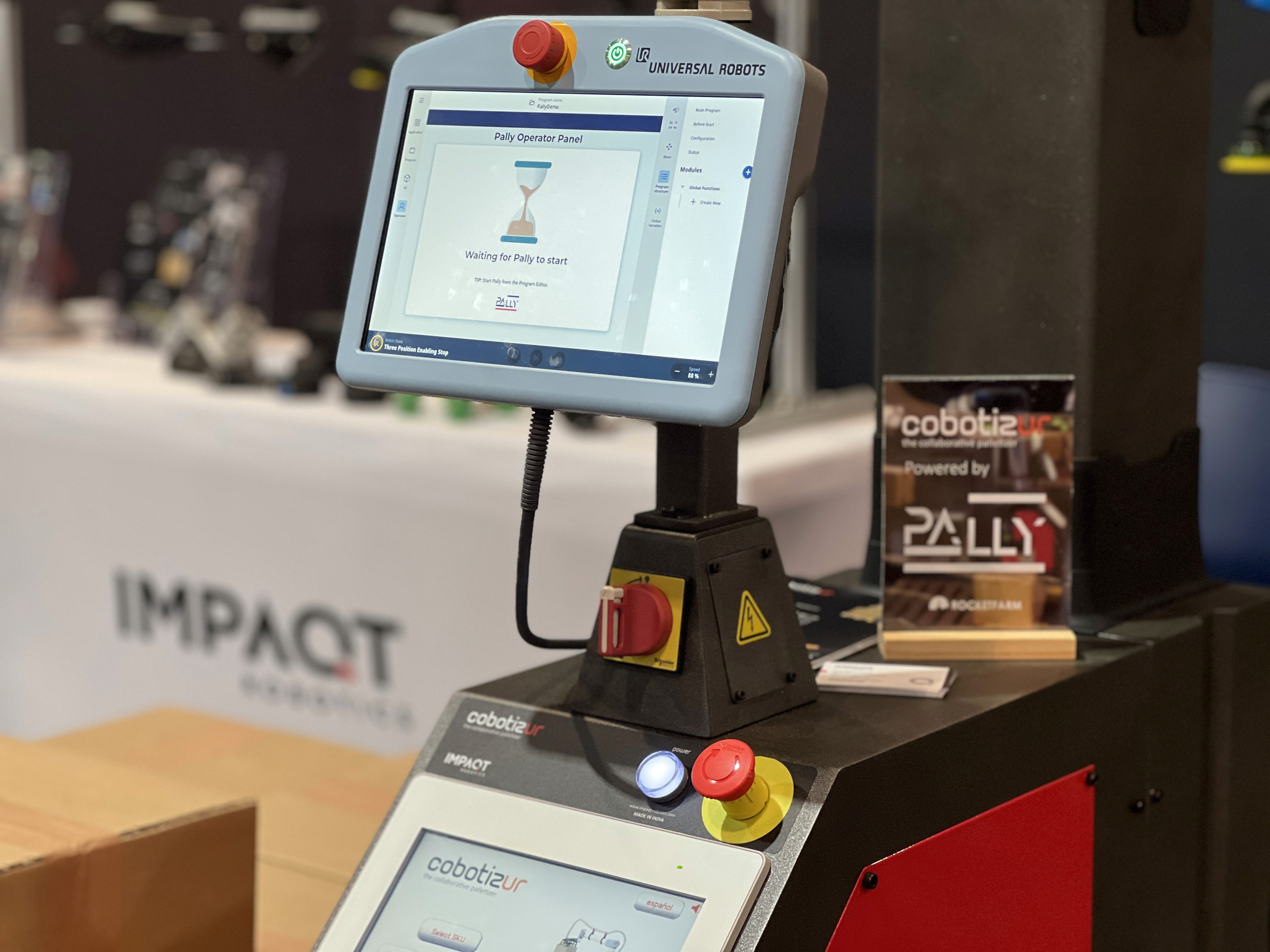
A look at why one-off palletizing projects slow down deployment and make scaling harder than it needs to be.
Palletizing is one of the most common starting points for automation. It is repetitive, physically demanding, and present in almost every production environment.
It is also where many projects take longer than expected, require more engineering effort, and become difficult to scale.
Why palletizing keeps starting from zero
Custom palletizing solutions are often chosen for flexibility. In practice, they tend to create more work than they remove.
Each new project requires its own design decisions, tooling setup, and integration work. Even when applications are similar, the solution is rarely reused in a meaningful way. Teams end up repeating the same steps, redesigning layouts, adjusting tooling, and rebuilding logic that already exists elsewhere, for example reconfiguring pallet patterns, revalidating reach, or adapting grippers for slightly different box sizes.
Over time, this repetition becomes a structural inefficiency. Engineering effort accumulates, timelines extend, and small variations between systems begin to create inconsistencies in performance and support. What looks like flexibility at the start often becomes dependency later, where every change requires engineering involvement.
When scaling begins to break
The limitations of this approach become clear when palletizing needs to expand beyond a single cell. A first installation may perform well and demonstrate clear value, but replicating it is rarely straightforward.
If each deployment requires fresh engineering, scaling turns into a sequence of individual projects rather than a repeatable rollout. Small differences lead to new adjustments, for example changes in pallet height, box orientation, or conveyor layout, and those adjustments introduce variation between systems.
As more cells are added, complexity grows. Engineering becomes the bottleneck, and what worked once does not easily translate into a scalable solution. The cost is not just in the first installation, but in every rollout that follows.
What a platform changes in practice
A platform-based approach starts from a different premise. Instead of treating palletizing as a series of standalone projects, it treats it as a structured, repeatable solution.
The platform is designed as a standardized hardware foundation, with interfaces to the robot and software already defined and tested to work together. This shifts the focus away from engineering each detail and toward deploying a solution that is ready to perform.
This has a direct impact on deployment. Traditional palletizing cells often require additional on-site work to assemble, adjust, and align components before production can begin. These final steps introduce delays and uncertainty.
A platform removes much of that friction by delivering a system that is already integrated. With cobotizur from Impaqt Robotics, palletizing can move from delivery to operation in under 60 minutes because the system arrives pre-engineered and aligned. Instead of building a solution on-site, teams install and start it.
The benefit extends beyond deployment. When a system is designed to be repeatable, each new installation becomes faster, more predictable, and easier to support. Operators work with familiar interfaces, maintenance teams deal with consistent components, and performance becomes more reliable across different lines or sites.
A platform approach reduces engineering effort, but more importantly, it removes the need to repeat it every time. This makes palletizing not just repeatable, but predictable across different lines, products, and sites. The real question is not whether a palletizing system works, but whether it can be deployed again without starting over.
From flexibility in theory to flexibility in practice
The role of a platform becomes clearer when it is used as part of a complete solution. This is where the collaboration between Impaqt Robotics, Universal Robots, and Rocketfarm comes together as a turnkey palletizing solution.
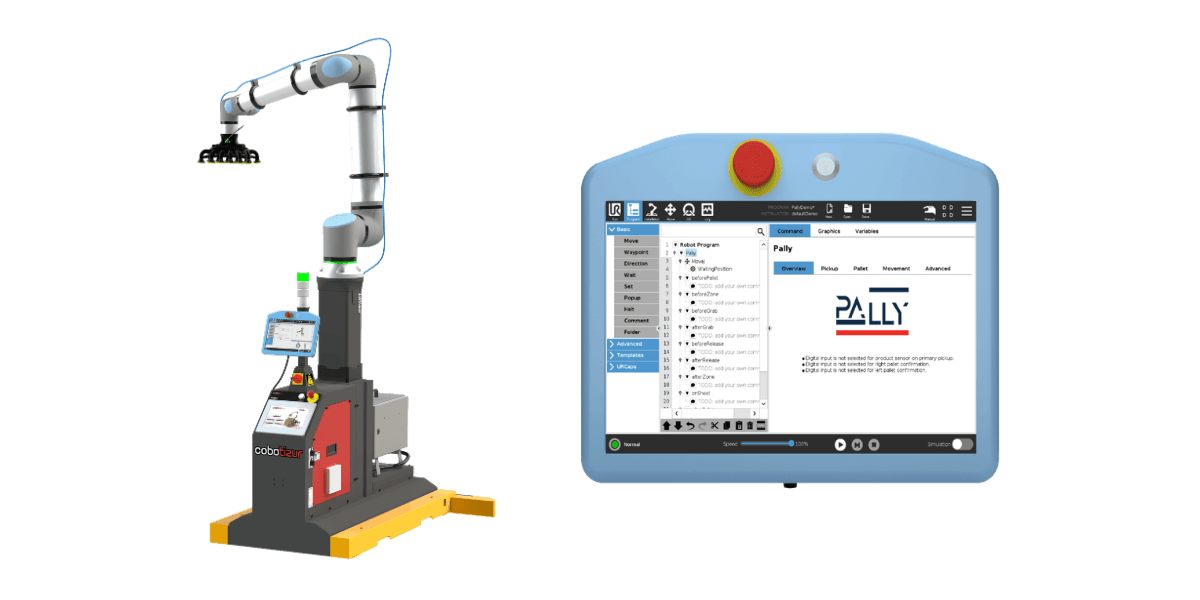
In this setup, cobotizur from Impaqt Robotics is the palletizing platform, providing a standardized hardware foundation with integrated components such as the gripper, cable management, tower lamp, and sensors. Combined with Universal Robots and Pally palletizing software from Rocketfarm, it becomes a complete palletizing solution. Universal Robots provides the robotic arm, while Pally structures the palletizing logic in a way that is accessible and repeatable.
This changes how the solution is used on a daily basis. Instead of relying on programming or engineering support, operators can define pallet patterns, adjust layouts, and manage changeovers themselves. This matters in environments where product variation is high. Flexibility is no longer something handled during design, but something that can be managed directly in production.
The result is a setup where flexibility is not just possible, but practical. Changes can be handled within the platform without interrupting production or requiring re-engineering. This makes the solution easier to deploy, but also easier to operate and scale over time.
One platform, different deployment paths
Not every palletizing application requires the same level of complexity. A platform needs to accommodate this without losing consistency.
cobotizur is designed to support different deployment paths while maintaining the same foundation. It is available in three versions: Lite, Standard, and Powered by Pally, allowing users to choose how much of the system is predefined and how much is open for integration.
The Lite version provides a flexible base for integrators or users who want to bring their own palletizing logic. It includes the essential controls while leaving room for customization. The Standard version delivers a complete, ready-to-run solution with hardware and software already integrated, making it suitable for companies looking for a straightforward path to automation.
For more demanding applications, the Powered by Pally version extends the platform with advanced palletizing capabilities using Pally, the palletizing software from Rocketfarm. It is designed for environments with higher variation, more complex patterns, or frequent changeovers, where structured software becomes critical.
This flexibility is supported by the hardware as well. cobotizur is available in both telescopic and fixed column configurations, allowing it to adapt to different layouts, payload requirements, and stacking heights. Despite these variations, the system remains part of the same platform, ensuring consistency in deployment and operation.
The takeaway
Palletizing does not struggle because the technology is not capable. It struggles when the way it is delivered does not support scale. Building each system as a custom project may solve the immediate need, but it introduces repetition, slows down deployment, and makes expansion more complex than it needs to be.
If palletizing needs to be deployed once, a custom solution may be enough. If it needs to be deployed across lines, sites, or regions, the approach itself becomes the limiting factor. A platform approach addresses this directly. It reduces engineering effort, shortens deployment time, and creates a consistent foundation that can be reused across applications.
Palletizing does not need another custom solution. It needs a platform.
See how this works in practice
If you want to go beyond the concept and see how a platform-based approach to palletizing is implemented, you can watch our on-demand webinar, From Cobot to Turnkey Palletizing Platform.
It shows how cobotizur hardware, combined with Pally palletizing software and Universal Robots, is deployed as a complete, structured palletizing solution.